
Medical Waste Shredder Machine for Sale | Hospital Infectious Waste Disposal Twin-shaft medical waste shredder for infectious, sharps, and pharmaceutical waste. Closed system, high-torque, autoclave compatible. Factory-direct with 12-month warranty. Get a quote.
advantage Durable and sturdy, with low energy consumption
Get a Quick Quote & Free Consultation →
Medical waste is not ordinary trash — it’s infectious, sharp, toxic, and heavily regulated. Hospitals, clinics, and disposal centers face strict requirements: waste must be rendered unrecognizable and safe before landfill or incineration. Manual handling risks needlestick injuries and pathogen exposure. Standard shredders cannot guarantee the sealed, sterile destruction demanded by health authorities.
Our Heavy-Duty Medical Waste Shredder is purpose-built for the unique dangers of healthcare waste. Featuring a fully sealed cutting chamber and optional integrated chemical or steam sterilization, it destroys infectious waste, sharps, pharmaceuticals, and pathological materials in a single, contained process. The twin-shaft, high-torque design reduces everything to unrecognizable fragments with no aerosol leakage — compliant with WHO, EU, and national biomedical waste regulations. It’s not just a shredder; it’s your frontline defense against infection risk and regulatory penalty.
| Model | Motor Power | Rotor Diameter | Chamber Size (L×W) | Blades Qty | Max. Input Width | Capacity (Mixed Medical Waste) |
|---|---|---|---|---|---|---|
| MSH-400M | 15+15 kW | 250 mm | 400×500 mm | 20 pcs | 400 mm | 200–400 kg/h |
| MSH-600M | 22+22 kW | 300 mm | 600×800 mm | 30 pcs | 600 mm | 400–800 kg/h |
| MSH-800M | 37+37 kW | 350 mm | 800×1000 mm | 40 pcs | 800 mm | 800–1,500 kg/h |
| MSH-1000M | 55+55 kW | 420 mm | 1000×1200 mm | 50 pcs | 1000 mm | 1,500–2,500 kg/h |
| MSH-1200M | 75+75 kW | 480 mm | 1200×1500 mm | 60 pcs | 1200 mm | 2,500–4,000 kg/h |
Capacity estimated for mixed clinical waste (plastics, textiles, glass, light metals) after sterilization. Throughput varies with material density, moisture, and sterilization method. Sealed system and sterilization integration available as option. Custom configurations for specific hospital waste streams.
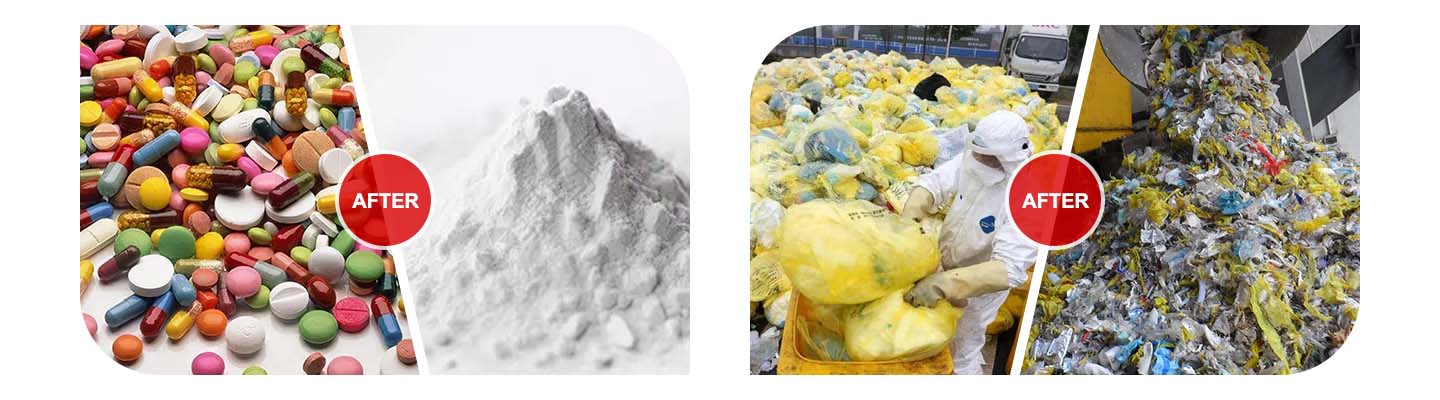
Infectious Waste: Contaminated gloves, gowns, bandages, gauze, cultures, and lab waste. Rendered safe and unrecognizable, complying with treatment standards before disposal.
Sharps & Needles: Syringes, hypodermic needles, scalpels, lancets, and broken ampoules. Shredded and crushed without manual pre-sorting, eliminating needlestick injury risk.
Pathological Waste: Tissue samples, surgical remnants, anatomical waste. (Note: pre-sterilization required before shredding). Reduced to homogeneous, unrecognizable fragments.
Pharmaceutical Waste: Expired drugs, pills, tablets, and small medicinal bottles. Destroyed beyond recovery to prevent diversion and misuse.
Plastic Medical Products: IV bags, tubing, dialysis cartridges, catheters, and specimen containers. Volume reduction for safe disposal or energy recovery.
Metal & Glass Containers: Small metal trays, glass vials, test tubes. Sheared and crushed into small fragments for final treatment.

Factory-Direct Engineering with Healthcare Specialization: When you contact us, you speak with engineers experienced in medical waste management requirements. We manufacture sealed rotors, gearboxes, and controls in our own facility, ensuring every machine meets stringent containment and durability standards — at a direct, factory price.
12-Month Comprehensive Warranty: All core mechanical, sealing, and electrical systems are fully covered. Should a containment or operational issue arise, our remote team provides video-guided diagnosis within 12 hours to get you back into safe operation fast.
Fast-Response Spare Parts & Genuine Compliance Support: We keep critical wear and sealing components in stock (blades, seals, gaskets, screens) for prompt dispatch. Our technical team provides honest maintenance guidance designed to keep your shredder compliant and productive, not to push unnecessary parts replacements.
Turn-Key Medical Waste Treatment Lines: From autoclave or chemical sterilization integration to shredding, conveying, and waste-to-energy or cement kiln feed preparation, we design and deliver complete, validated systems. One partner, one guarantee — ensuring your facility passes every regulatory audit.
Describe your medical waste stream and required treatment capacity. Send us your specifications today. Our specialized engineers will design a compliant, sealed shredding solution and provide a complete quotation within 24 hours.
Tell us your production requirements and we will provide you with the best solution within 24 hours.
We're here to help with all your inquiries. Send us a message and we'll get back to you promptly.
Fill out the form below and we'll contact you soon